March is fast approaching. As that extensive, snow-perbole winter slips into the rear view mirror, dust off the straw and put the Borsalino back in its box.
The March issue of The Monthly Ledger is in production as I type. This month we explore the Miami haunts of Travis McGee in our monthly column, [FIND] Vice. Get ready for a fine cigar and another tasty cocktail from our operatives at UpTowns and The Patterson House.
Brace for the oncoming spate of sunny days and check your email in-box the first part of next week for more news from [FIND] Investigations.
THH
Tuesday, February 22, 2011
Monday, February 21, 2011
Quick Response Codes and how you can use them...
Here at [FIND] Investigations, we try to keep up with new technology. That’s why we are so proud to bring you this ten-year-old technology from Japan . QR Codes, or 2D bar codes, are turning up in magazines, on billboards, emblazoned across T-shirts, and embedded in airline tickets. I found one in a Tag Hauer advertisement on the back of Fast Company magazine this weekend. Simply put, a QR Code is a version of a bar code that allows you to put complex information into a graphical format.
Want to hand over your contact card with a quick scan? Generate a QR Contact code.
Want to deliver readers to your website? You could, as we all do, put your web address on your business card and hope they remember to key in the url when they get back to the office. Or, you could place a QR code on your business card and have them scan it with their smart phone. Hey presto, they’re taken directly to your homepage or blog.
You can build a code that, when scanned by an iPhone or Droid, delivers a prospective client to your Facebook page, twitter feed, RSS feed, etc. etc. You can even have the code offer them the chance to “Like” or follow your brand. I just created one code that, once scanned into the iPhone, automatically likes our company’s Facebook page.Here are a few simple ideas for ways to employ QR Codes in your marketing plan:
Ø Business Cards – Put a QR Code on your card that contains your contact information. When someone scans your card into their smart phone, a new contact is automatically added to their phone.
Ø Marketing Materials – Place a QR Code somewhere on your brochure or one pager. Have that code instantly deliver the reader to a specific section of your website or blog that relates to the service.
Ø Giveaway Items – Say you’re at a trade show. You have a booth set up. Why not have a QR Code on those key chains, pens, and T-shirts?
Ø Scavenger Hunts – [FIND] Investigations is working on setting up a scavenger hunt in conjunction with our client appreciation dinner this next fall. We’re considering using QR Codes for clues.
I guess the point of this is quite simple: make it easy for people to connect with you and your business. Make your brand--that idea or image you’re trying to build--easy to find. Create opportunities for people to hear your story, that narrative that you’ve created.
Here are a few sources for QR Code generators.
If you have an iPhone or a Droid, download a QR reader. Search the App store for QR Code Readers or 2D Code readers. Scan the code at the top of this post, share it on Facebook. Put these little codes to work for you today.
Labels:
[FIND] Investigations,
2D codes,
Droid,
iPhone,
Marketing,
QR codes,
technology
Saturday, February 19, 2011
Does mood affect the "Aha" moment?
Next time you're struggling with a blank spot in a crossword puzzle, have somebody tell you a joke.
Scientists at Northwestern University found that their study subjects were more likely to solve word puzzles quickly, in sudden flashes of insight, immediately after watching a funny video.
Sometimes problem-solving calls for analysis, intellect, a systematic trial-and-error approach. But all good detective fiction also highlights the intuitive moment, the leap of logic that originates deep inside the unconscious mind.
Neuroscientists often use puzzles to try and understand those light-bulb moments. A few of these now-famous studies are highlighted in this New York Times article, Tracing the Spark of Creative Problem-Solving.
In the Northwestern study, researchers observed brain images as subjects watched a timed puzzle unfold, and found that people tended to intuit the solutions faster if their moods were positive. Scientists believe that a joke or amusing video may cause the mind to "widen its attention, in effect making it more open to distraction," which may just ready your brain for the "aha" moment.
You can test your own insight here with this quick, interactive video puzzle at the NYTimes website.
Scientists at Northwestern University found that their study subjects were more likely to solve word puzzles quickly, in sudden flashes of insight, immediately after watching a funny video.
Sometimes problem-solving calls for analysis, intellect, a systematic trial-and-error approach. But all good detective fiction also highlights the intuitive moment, the leap of logic that originates deep inside the unconscious mind.
Neuroscientists often use puzzles to try and understand those light-bulb moments. A few of these now-famous studies are highlighted in this New York Times article, Tracing the Spark of Creative Problem-Solving.
In the Northwestern study, researchers observed brain images as subjects watched a timed puzzle unfold, and found that people tended to intuit the solutions faster if their moods were positive. Scientists believe that a joke or amusing video may cause the mind to "widen its attention, in effect making it more open to distraction," which may just ready your brain for the "aha" moment.
You can test your own insight here with this quick, interactive video puzzle at the NYTimes website.
Labels:
creativity,
insight,
problem-solving,
puzzles
NPR Series on Death Investigation in America
We imagine an American criminal investigations system that looks a lot like CSI: with 21st century science, driven professionals, and limitless resources at our disposal, no bad deed should ever go unnoticed, or unpunished.
The reality of forensic science in America is startlingly different. A collaboration between NPR, ProPublica, and PBS Frontline uncovers the alarming state of America's coroner and medical examiner offices.
The investigative series Post Mortem: Death Investigation in America exposes a deeply-flawed system that allows coroners without medical degrees to diagnose causes of death, sends innocent people to prison, and allows many crimes to go unpunished, due to mistaken cause-of-death findings. Budget shortfalls and a shortage of "death detectives" leave many coroner offices overwhelmed with cases and incompetent coroners continuing to sign death certificates despite a history of mistakes.
The reality of forensic science in America is startlingly different. A collaboration between NPR, ProPublica, and PBS Frontline uncovers the alarming state of America's coroner and medical examiner offices.
The investigative series Post Mortem: Death Investigation in America exposes a deeply-flawed system that allows coroners without medical degrees to diagnose causes of death, sends innocent people to prison, and allows many crimes to go unpunished, due to mistaken cause-of-death findings. Budget shortfalls and a shortage of "death detectives" leave many coroner offices overwhelmed with cases and incompetent coroners continuing to sign death certificates despite a history of mistakes.
Tuesday, February 1, 2011
[FIND] Diligence
What’s under the surface is not always bad, not always a deal killer; but if it is, you need to know.
Human capital: the stock of competences, knowledge, and personality attributes embodied in the ability to perform labor so as to produce economic value. It is the attributes gained by a worker through education and experience. Sullivan, Arthur; Steven M. Sheffrin (2003). Economics: Principles in action.
As a venture capitalist, you seek great ideas, business plans, widgets the world needs. But when it comes to putting your money behind a concept, our thinking is this: You’re not investing in a company as much as you’re endowing human capital.
In a recent survey of private equity investors, nearly 70% of the respondents indicated that they believed “…poor company performance is either very often or always attributable to management issues.” But while the investors said, by and large, that they were moving away from, “…a more instinctive approach when it comes to picking talent,” they are still using outdated and loosely defined methods of assessing human capital.
What we do – the broad view.
[FIND] Investigations performs background investigations to help limit your financial and reputational risk.
What we do – the more specific view.
[FIND] Investigations can locate, identify, and/or find the following:
· Non-disclosed businesses/relationships
· Controversial media attention
· Lawsuit history
· Regulatory issues
· Conflicts of interest (IP theft, fraud, etc.)
· Resume Fraud
· Indications of financial stress
· Criminal history
· Personal history
What makes us different?
[FIND] Investigations produces well written, comprehensively researched, and thoroughly-documented reports. Our final report is a distilled analysis of potential areas of concern, not just a list or summary. We recommend deeper research where necessary. We look into problem areas in detail and help you determine what action might be appropriate: is this a deal-killer, an issue to "spin," or just a minor obstacle?
We approach our work as working professionals with backgrounds in business and research. We are writers, journalists, appraisers, analysts…we do this work for a living, not as a post-retirement-hobby. You can expect a lack of jargon in our reports. The passive voice is avoided whenever possible.
What you can expect – Clients' Bill of Rights.
[FIND] Investigations believes that you have the right to, and should demand, the following:
· You have the right to an investigator who is as intelligent as you are.
· You have the right to receive professional service.
· You and your employees have the right to be treated with respect at all times.
· You have the right to a well written, well reasoned, and grammatically correct report.
· You have the right to a good-faith estimate of total project costs, up front.
· You have the right to expect phone calls and emails to be returned within at least 24 hours.
· You have the right to expect ethical conduct and complete confidentiality.
· You have the right to a detailed invoice, clearly showing all charges.
[FIND] Vice - Jake Gittes
"What I do for a living may not be very reputable. But I am. In this town I'm the leper with the most fingers." Jake Gittes, "The Two Jakes"
Loach: What happened to your nose, Gittes? Somebody slammed a bedroom window on it?
Jake Gittes: Nope. Your wife got excited. She crossed her legs a little too quick. You understand what I mean, pal?
Equal parts mystery and psycho-thriller, the 1974 movie Chinatown revived the film noir genre and gave the world one of [FIND]'s favorite fictional private eyes, Los Angeles gumshoe J.J. "Jake" Gittes, played by Jack Nicholson.
Screenwriting professors everywhere get all misty about Robert Towne's superbly-crafted screenplay, a dark tale of murder, corruption, and water rights set in 1930s Southern California. Towne's stark, whittled-down dialogue breathes life into Gittes, a cynical, every-man-for-himself divorce-shamus resplendent in a back-belted white linen suit and straw hat.
Gittes isn't afraid to compromise to the very edge of legality and sleaze, but the evil he encounters surrounding his mysterious client, Mrs. Mulray (Faye Dunaway), pushes the limits of even Gittes's flexible morality. Embittered by some murky past as a cop in L.A.'s Chinatown, in which his job was to "do as little as possible," he's learned that nothing is ever as it seems.
Gittes's momentary resurgence as a man who protects the weak and fights for what's right comes to naught, in a dark, climactic scene re-tooled by director Roman Polanski from the original screenplay. Gittes, again, steeps in disgust at the futility of salvation in a venal world. As the two watch the tragedy unfold, Gittes's partner, Lawrence Walsh, tells him, "Forget it, Jake. It's Chinatown."
The Cocktail
James Hensley manages The Patterson House, a favorite watering hole of ours, and just the kind of dramatically-lit speakeasy Gittes would have loved, if only he could pay the bar tab. Hensley cooked up the ideal mouth-shattering cocktail in honor of that rough-cut L.A. gumshoe:
The Chinatown
James Hensley manages The Patterson House, a favorite watering hole of ours, and just the kind of dramatically-lit speakeasy Gittes would have loved, if only he could pay the bar tab. Hensley cooked up the ideal mouth-shattering cocktail in honor of that rough-cut L.A. gumshoe:
The Chinatown
1.5 oz. Lunazul Reposado Tequila
1/2 oz. Chichicappa Mezcal
3/4 oz. Fresh lime juice
3/4 oz. Ginger syrup
1/2 oz. Aperol
Place all ingredients in a shaker with ice and shake. Strain over ice in a rocks glass and garnish with ginger candy.
The Cigar
PI Gittes seems to need to unwind, relax, let his thinning hair down, whatever one may call it, with a cigar after an investigation that left him with a mutilated nostril. He doesn't need anything too strong, but something smooth and capable of creating a contemplative distance from the day's events.
The Zino Classic No. 1 would do just fine. It is mild to medium, depending on one's palate. The Ecuadorian wrapper complements the cigar's Dominican and Honduran tobacco to reveal a very slightly bitter, buttery, woodsy flavor.
Wrapper: Ecuador
Binder: Honduras
Filler: Dominican Republic, Honduras
Sunday, January 23, 2011
On Plain English
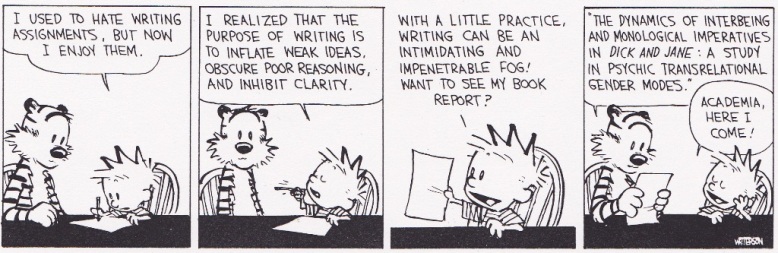
Muddled, unintelligible writing abounds in academia, business, and government. Champions of plain English say clear, well-crafted language can change the world. Here's how.
"The fight against bad English is not frivolous," George Orwell wrote in his 1946 essay Politics and the English Language. "...If thought corrupts language, language can also corrupt thought."
The framers of our Constitution created a government with 4,500 well-chosen words; so why does the Senate health care bill require 200,000 words and more than 2,000 pages of inscrutable babble? This torrent of words not only reflects muddled thought; it produces muddled thinking and muddled debate.
For a succinct explanation of why this matters, watch Alan Siegel's four-minute TED talk on how simplifying legalese would make the world a better place. How many hours have you squandered trying to puzzle out incomprehensibly long tax forms, credit agreements, and legal contracts? And if governments and corporations made paperwork brief, simple, and easy-to-understand, how much harder would it be for them to impose "stealth provisions" (like adjustable interest rates, hidden fees, or confusing tax codes) on citizens and customers?
“If you can’t explain what you’re doing in plain English, you’re probably doing something wrong,” economist Alfred Kahn wrote in a famous memo that urged fellow civil servants to compose their letters and reports clearly and succinctly. The passive grammatical construct particularly irked him:
"The passive voice is wildly overused in government writing. Typically its purpose is to conceal information — one is less likely to be jailed if one says, ‘He was hit by a stone,’ than if he says, ‘I hit him with a stone...The active voice is far more forthright, direct, humane."
Think “Mistakes were made.“ William Schneider coined the term “past exonerative tense” to describe this linguistic construct, and William Safire called it a “passive-evasive way of acknowledging error while distancing the speaker from responsibility for it.”
It's not only the passive voice that makes officialspeak feel so dehumanizing. It's the unnecessarily complex language and overuse of incomprehensible jargon, which conceals ideas instead of clarifying them. Echoing Kahn, Siegel says that simplifying legal writing reconnects institutions with the people they serve.
"I define simplicity as a means to achieving clarity, transparency, and empathy, building humanity into communications."
As private investigators, we deal in information. That's why we should be practicing the lost art of clarity in our own work, by writing reports in the kind of simple prose advocated by Siegel, Kahn, and Orwell. Instead of using the absurd officialese so often seen in police reports (and described to comic effect in this newspaper article), why not write our reports the way we tell stories, using simple subject-action verb constructs and ordinary, familiar vocabulary? Precise language doesn't leave much room for misinterpretation, it ensures that clients understand exactly who did what, and when, and it makes you look like a smart, savvy character fully responsible for his actions (i.e. "I did this" instead of "This was done...").
We here at [FIND] Investigations believe that the private investigator should wield his pen with the precision of a scalpel, in the service of reason, intellect, and humanity.
In his essay, "Politics and the English Language," Orwell offers a few remedies for the kind of bad writing that infects government, business, and academia. Here’s an excerpt:
1. Never use a metaphor, simile, or other figure of speech which you are used to seeing in print.
2. Never use a long word where a short one will do.
3. If it is possible to cut a word out, always cut it out.
4. Never use the passive where you can use the active.
5. Never use a foreign phrase, a scientific word, or a jargon word if you can think of an everyday English equivalent.
6. Break any of these rules sooner than say anything outright barbarous.
For more examples of pompous and execrable writing, see this WSJ article and the Bad Writing Contest website. -KDG
"When the subject is strong, simplicity is the only way to treat it." -Thomas Jefferson
Subscribe to:
Posts (Atom)